In this post, I tested how AI local search platforms—Google AI Overviews, Perplexity, and ChatGPT—decide who’s ‘best’ in your city. We’re talking about local search visibility in the era of AI. If you’d like to fast forward to a TLDR version of what we cover here, skip right to our FAQ.
If your brand or business is struggling with online visibility, feel free to schedule a free Google Meet with me and we’ll talk things out!
Our Challenge in AI Local Search
If you ask Perplexity, Google, and ChatGPT the same simple question — “Who’s the best plumber (or tax lawyer, or marketing agency) near me?” — you won’t get the same answers. Each platform leans on different trust markers, and those trust markers vary, depending on what you’re looking for. For some queries, one platform will favor consumer review portals, while on others professional or peer rankings are principal influencers. Then there’s the influence of local journalism “best of” lists and, finally, local chatter—in the form of forums such as Reddit.
Understanding these differences is the new playbook for local business search visibility. Here’s how the sources shook out in our three test searches.
AI Local Search Test 1: What is the best plumbing company in Philadelphia, PA?
When it comes to direct-to-consumer trades, the tendency of all the platforms is to lean into consumer-facing review sites and respected local journalism. Specifically:
- Perplexity pulled directly from Yelp, Angi, Checkbook, and even Reddit threads, while also mixing in lists from Philadelphia Magazine (a popular perceived local authority) and Expertise.com.
- Google AI Mode leaned heaviest on Google and Yelp reviews, plus Angi, HomeAdvisor, BBB, and Best Pick Reports.
- Google AI Overviews gave more weight to editorial awards (Philly Mag’s Best of Philly) and firm longevity.
- ChatGPT blended Google star ratings with Philly Mag picks and Reddit recommendations, skipping Yelp and Angi.
Takeaway for plumbers (and, probably, many other local direct-to-consumer businesses):
Presence and aggregate reviews scores from Google Business, Yelp, and Angi are non-negotiables. Local editorial recognition and authentic community mentions can tip the balance when AI wants further local trust signals.
AI Local Search Test 2: What is the best tax law firm in San Francisco?
For higher-stakes professional services like the law, consumer reviews take a back seat. Here, AI platforms look instead to the legal peer-ranking ecosystem.
- Perplexity emphasized Chambers, Best Lawyers, Vault, and BCG, with some Justia and Yelp for boutiques.
- Google AI Mode anchored in Chambers, Legal 500, and Vault, but acknowledged Google/Yelp reviews for smaller firms.
- Google AI Overviews largely parroted peer rankings, with little reliance on consumer reviews.
- ChatGPT was the purest: Chambers, U.S. News – Best Law Firms, Best Lawyers, Super Lawyers, nothing consumer-facing.
Takeaway for law firms: Visibility comes from being in the right directories — Chambers, Best Lawyers, U.S. News, Super Lawyers. For boutiques, Google and Avvo reviews still matter, but peer recognition dominates.

Why Reviews & Rankings Matter More for Some Services than Others
Economists have a name for services like plumbing, law, or marketing: credence goods. These are services where the buyer can’t really judge the quality, even after the work is done.
- A shirt (a “search good”) can be inspected before you buy.
- A restaurant meal (an “experience good”) reveals its quality as soon as you taste it.
- But a tax lawyer’s strategy? Or whether your plumber used the right gauge of pipe? You’ll probably never know for sure. That’s a credence good.
And this note, which I present—directly from ChatGPT— as a rationale underscoring how AI platforms evaluate trust:
“Because consumers can’t directly evaluate expertise, we rely on proxies of trust — reviews, peer rankings, awards, directory listings, even Reddit chatter. Each AI platform is essentially deciding which proxy to trust most.”
That’s why plumbers surface on Yelp, lawyers on Chambers, and agencies on Clutch. It’s not the “truth” of who’s best — it’s simply the “trust environments” these platforms scrape.
AI Local Search Test 3: What is the best Digital Marketing Agency in Philadelphia?
Things change when we start looking for B2B service providers, such as marketing agencies. The relative absence of peer-to-peer directories forces all the major platforms to focus on B2B-focused directories. (Note: this speaks to the unfortunate “pay to play” means of trust-verification which has long been a fixture of local SEO success…)
- Perplexity spotlighted Clutch, UpCity, SEMrush Partners, with editorial nods from BuiltIn and First Page Sage.
- Google AI Mode echoed Clutch but also scanned Google/Yelp and local lists.
- Google AI Overviews elevated editorial lists (BuiltIn, Acadium, Sagefrog) but was lighter on raw review portals.
- ChatGPT leaned hard on Clutch, SEMrush, BuiltIn, and Designity, ignoring consumer review sites altogether.
Takeaway for agencies: Directories like Clutch are essential. Make sure your agency profile is airtight with detailed case studies and verified reviews. UpCity and SEMrush Partners also matter. Editorial mentions in industry roundups add credibility AI recognizes.
The Playbook at a Glance
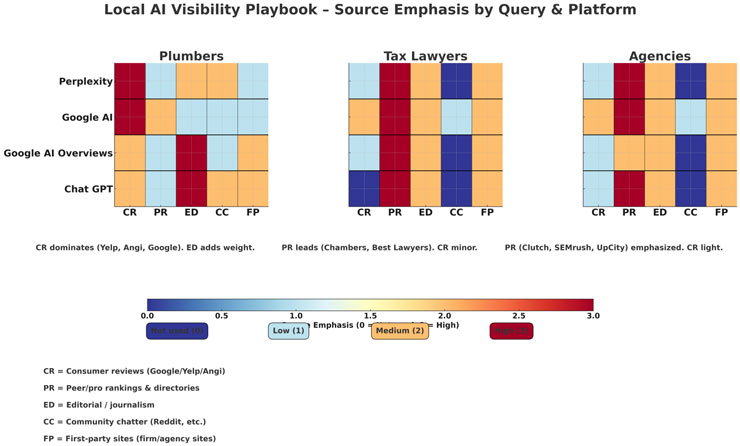
Different AI platforms weight different trust signals. Red = heavy emphasis, blue = barely used. The patterns are clear: consumer reviews matter for the trades, peer rankings for law, B2B directories for marketing agencies.
Closing Note
The lesson is simple but powerful: “best” isn’t an absolute anymore. It’s whatever set of signals an AI happens to trust. If you want to surface in answers tomorrow, you need to show up in the ecosystem of credibility that your audience’s AI of choice happens to scrape.
Shameless Self-Promotion: If you’re struggling with online visibility in the era of AI, feel free to schedule a free 15 minute chat with me.
FAQ
Q1. What is AI local search?
AI local search refers to the way AI-powered platforms like Google AI Overviews, Perplexity, and ChatGPT surface business recommendations when users ask “What’s the best [service] near me?” Instead of showing a list of links, these platforms compile answers from review sites, directories, and editorial sources.
Q2. How does AI local search differ from traditional SEO?
Traditional SEO relies on optimizing your website to rank in Google’s organic results. AI local search, by contrast, pulls from review platforms, peer directories, and editorial mentions—sources that function as proxies of trust rather than on-page optimization.
Q3. Which sources matter most for AI local search?
It depends on your industry. For trades like plumbing, consumer reviews dominate (Google Business, Yelp, Angi). For professional services like law, peer rankings (Chambers, Best Lawyers, Super Lawyers) lead. For B2B agencies, directories such as Clutch and UpCity carry weight.
Q4. Why is it harder to rank in AI local search?
Because AI platforms don’t evaluate your work directly—they rely on signals of credibility from third-party sources. Economists call these kinds of services “credence goods”: the customer can’t judge the quality directly, so reputation proxies (reviews, rankings, awards) matter more.
Q5. How can a business improve visibility in AI local search?
Focus on the trust signals that your platform of choice favors. That means maximizing Google Business reviews, earning placements in peer-ranking directories, or strengthening your presence in B2B review sites. Local editorial mentions and authentic community chatter (like Reddit) can also tip the balance.
Post Navigation
 How to Prepare Existing Content for AI search
Subscribe to Sitegeist
Subscribe and receive timely, strategic advice on what's trending in
digital development, design, and marketing.